
You Only Serve Once
How Ariel's reelection bid could jeopardize his wife's judicial campaign.

You know the phrase Y.O.L.O (You Only Live Once), but are you familiar with Y.O.S.O? Probably not, since it’s just some stupid thing I made up literally five minutes ago. It means You Only Serve Once, and it applies to the relatively narrow category of soon to be one-term politicians. Whereas Y.O.L.O connotes a devil-may-care willingness to take on increased risk, Y.O.S.O suggests additional elements, such as bitterness, resentment, and the trash-the-place-on-the-way-out attitude that sets in for disgruntled politicians recently rejected by their constituents. It’s basically the dark side of lame-duck politics.
Unsurprisingly, the first commission meeting following April’s special election was positively brimming with Y.O.S.O thanks entirely to Dr. Castro and Ariel, or as the endlessly entertaining Rip Holmes affectionately refers to the latter, “Spartacus.” Still reeling from a referendum that not only set their entire political project ablaze, but also reduced their already low odds of reelection to effectively zero, both Spartacus and the doctor spent much of the meeting engaged in what was an especially churlish display of resistance theatre.
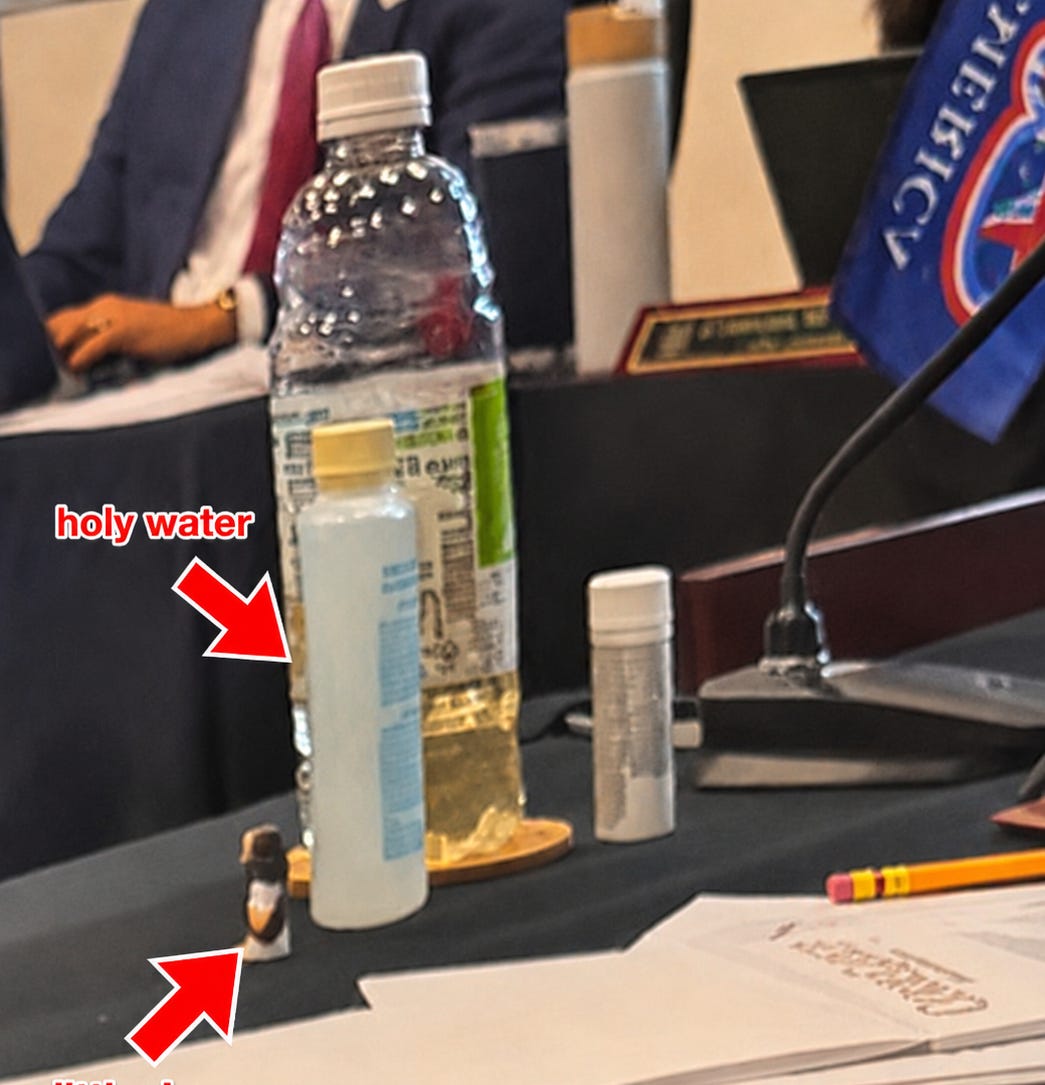
Much of it we’ve seen before, such as the constant interruptions, shouting, walking out, and various other tactics designed to diminish the mayor’s role as chair. But there were some novel acts as well, like Dr. Castro, clearly channeling her spirit animal Mrs. Cruzchev, conspicuously positioning a bottle of holy water and a tiny Jesus figurine on the dais between herself and Lago, presumably for some kind of spiritual protection. What a gem, that one.
But the best act of all, hands down, was Ariel’s latest holier-than-thou sermon, delivered, per his custom, as a kind of deflection from one of his many transgressions. Remember, Ariel’s sanctimony rises in direct proportion to his guilt. The guiltier he is, the more indignant and preachy he becomes, and because he knew he was getting snookered by Lago’s anti-phishing item, he came prepared with one of his most righteously indignant speeches yet.
Well, maybe only somewhat prepared, as evidenced by his cringeworthy misattribution of an iconic Ronald Reagan quote that’s so famous it has its own Wikipedia page.
Yeah, so for the record, it’s not “here you go again,” it’s “there you go again,” and it wasn’t Ross Perot, the unsuccessful independent 1992 presidential candidate, but Ronald Reagan, perhaps the most famous Republican of the 20th century, who said it (good job to Lago, who picked up on this). It’s a forgivable error in most contexts, but not when deployed in service of one’s bid to position oneself as some sort of Super Republican whose limitless wisdom flows from his firm grasp of American history.
But, look, the last thing I want to do is pump out yet another post exclusively poking fun at KFC’s amusing but ultimately frivolous antics. As the first Republican president George Washington said when he freed the slaves at Gettysburg, “Ask not what your country can do for you, but what you can do for your country.” Which is really just a fancy way of saying “Always keep your Substack fresh and interesting.”
So rather than burn the word count on yet another recital of KFC's recent hijinks, however amusing that would be, I'd rather use the occasion to explore the most interesting question facing Gables politics at the moment. Now that campaign season has officially begun and qualifying is roughly a month away, the question on everyone's mind is whether Ariel will mount a reelection campaign or quietly accept his one-term fate.
You can’t always get what you want
I’ll begin by tipping my hand. I wholeheartedly, enthusiastically, and selfishly want Ariel to seek reelection. Yes, he’s one of the most toxic people to ever hold elected office in our beloved city, but the voters know that now and have put him in check accordingly. He has no power on the dais, and whatever extracurricular chicanery he can manage as a commissioner, he can just as easily manage in his natural state as unemployed disgruntled agitator. If anything, he’s more capable as a private citizen, as holding office has constrained him by virtue of the attendant guardrails, e.g. ethics and Sunshine laws.
I want Ariel to run because I want the six months of amazing, risk-free entertainment it will provide. The man has no chance of being reelected. His numbers were already substantially worse than Kirk's heading into the April 2025 elections, a problem he has done nothing to remedy over the past year. To the contrary, he's made matters exponentially worse for himself by getting caught red-handed running the People Count USA phishing scam and then going AWOL for several months as a damage control strategy. To be frank, he hasn't been the same since the scandal broke. He seldom shows up to city functions, barely logs into his city email account much less uses it, and writes nothing in the way of material legislation. It's as if the combination of losing Kirk and thus control of the commission, losing his pet city manager Amos Rojas, having his 101% pay raise rescinded, and being outed as the architect of a fraudulent surveillance operation took all the wind out of his sails. He simply isn't interested in the job anymore beyond the paycheck and the occasional cosplay opportunities that accompany it.
Ariel’s goose is cooked and he knows it, which is why he now spends much of his free time (which is all of his time thanks to his being terminally unemployed) abroad LARPing as a diplomat/dignitary/Catholic influencer/state rep/congressman. It’s his way of laying the groundwork for his latest set of delusional fantasies, which I’m told may include either running for congress or challenging Demi Busatta for state rep. Good luck with that, pal.
But as far as the LARPing itself goes, I say eat your heart out, Ariel. LARP all you want, because at the end of the day, you are to a dignitary what this guy is to Freddie Mercury:
All that said, I’m afraid he won’t run, simply because he can’t, not without placing his wife’s newly minted judicial campaign in serious and unnecessary jeopardy.
Yes, that’s right. Ariel’s wife, Monica Segura, is running for circuit court judge. I know this because full-time day-drinker/part-time blogger Elaine De Valle just wrote a thinly veiled hit piece against Monica’s opponents. There was also this subtle and dignified display in front of Duffy’s the other day:

Let’s see, the oversized headshot (where none would be more appropriate), the American flag in the background, the familiar font and use of cursive, the cheesy gavel graphic…no, that campaign collateral doesn’t have Ariel’s fingerprints on it at all!
Anyway, running for judge is an entirely different animal from running for political office, mainly because it’s supposed to be an unambiguously apolitical endeavor. In fact, it has to be, thanks to a robust corpus of laws and guidelines designed to insulate the judiciary from the partisan circus of ordinary politics. Florida’s Code of Judicial Conduct prohibits candidates from, among other things, pledging how they’ll rule, endorsing other candidates, personally soliciting contributions, or engaging in partisan political activity of any kind. It even constrains a candidate’s rhetoric. In sum, if running for political office is a free-for-all, running for judge is more like navigating a minefield.
Now imagine having to navigate that minefield all while your husband is simultaneously running for political office. Then imagine that your husband isn’t just any husband, but Ariel F’n Fernandez, one of the most recklessly conniving figures in local politics, a man who’s spent the better part of a decade cultivating an impressively long list of political enemies, and who, thanks to a host of dumb and rash decisions over the past three years, has placed himself squarely under the microscope of journalists and state investigators alike.
It would be a difficult task to say the least. In fact, mistakes have already been made. I won’t get into the details on that just yet, but let’s just say that simultaneous spousal campaigns require robust firewalls, and firewalls aren’t exactly Ariel’s strong suit.
Then, of course, you have the optics. There’s something a bit too ambitious, too eager, and too presumptuous about a married couple simultaneously running for office—it screams “grift.” Now add in the further wrinkle that the spouse running for political office happens to be a political consultant clearly responsible for a significant portion of the judicial candidate's campaign infrastructure, and the whole arrangement starts to look less like two parallel campaigns and more like a single political operation wearing two hats. From there, it goes from bad to worse very quickly.
Finally you have the various scandals, particularly Ariel's phishing scheme. I'm sure many, Ariel included, think Lago's recent rekindling of that issue was little more than the beating of a dead horse. To the contrary, it was a deceptively deft gambit. By having previously voiced support for the very resolution now back on the dais, Ariel had effectively boxed himself in. Lago seized on that fact by doing something long overdue, namely, confronting Ariel head-on and on the record, demanding that he either admit or deny the allegations directly. Ariel, in a spectacularly uncomfortable moment, refused to do either.
That refusal was huge thanks to the context. Ariel was already on record agreeing that People Count USA and similar phishing schemes were contemptible and deserved to be referred to the authorities (which is a bit like a serial killer cofounding a charity for his victims' families). He was then handed the opportunity to, for once, unequivocally deny his involvement in the very scheme that inspired the resolution, and he simply couldn't do it.
That right there is what a lawyer would flag as a tacit admission. The relevant doctrine, in essence, holds that when a person is confronted with an accusation under circumstances in which an innocent person would naturally and emphatically deny it, the failure to deny can be received as evidence of the truth of the accusation. Ariel had every incentive to deny, every opportunity to deny, and a public stage practically engineered for the denial. Yet he refused. Combine that with the technical evidence already in the public record, and whatever exceedingly small reservoir of plausible deniability Ariel might have once drawn from instantly evaporates.
Moreover, that tacit admission removes one of the last remaining barriers to meaningful escalation. Remember, the People Count USA surveillance polls went out to thousands of Coral Gables residents, every one of whom has potential standing to bring a civil action against Ariel—privacy claims arising from the absence of required disclosures, and fraudulent misrepresentation claims arising from the use of falsified headers and fictitious entities to lure recipients into clicking tracking links.
There's also the matter of at least one resident with a viable public records claim against the city, stemming from Ariel's denial of having any records pertaining to the People Count USA surveys, a denial that looks considerably worse now that he has effectively conceded his involvement on the dais.
By the way, if escalation seems far-fetched, remember we already saw a private citizen file a John Doe lawsuit just to subpoena Mailchimp’s records. Moreover, this isn't the kind of suit that has to go the distance to inflict catastrophic damage. All it would have to do is reach discovery, where Ariel would finally be forced to hand over the records he's been hiding and sit through hours of deposition under oath. For a man who has spent three years frantically managing what the public sees, this would all be extremely problematic for Ariel.
It would also be extremely problematic for his wife. Like it or not, her judicial campaign would be contaminated by the fallout—and judicial campaigns are uniquely allergic to contamination. Even in the most charitable scenario, where Monica played no role whatsoever in Ariel's schemes, the optics of a circuit court candidate whose husband is being deposed about fraud and privacy violations are, to put it mildly, unhelpful. And if she did play a supporting role? Game over.
Put it all together and what do you have? An attorney who has just staked her professional reputation on a run for judge, married to Ariel, the Wile E. Coyote of local politics, a man with more baggage than a Samsonite store, mulling a reelection bid with no realistic chance of succeeding. All that bid would do is drag a massive amount of unwanted and mostly avoidable heat onto Monica. Every pox Ariel brings upon the Fernandez house would infect her too. And Monica knows this. She is, by all accounts, considerably smarter than her husband, and apparently every bit as ambitious.
So allow me to offer a cold, hard, realpolitik summation. Ariel is not popular. Ariel is not well-liked. The vast majority of the electorate wants him off the dais, and that majority includes a particularly capable subset that is both willing and equipped to go to war to make sure it happens. A graceful exit on Ariel's part would likely see his pursuers call off the hounds, having gotten what they wanted, while a defiant bid to cling to power will see the entire pack let loose. That's just the nature of the beast.
Indeed, as much as I'd love to see Ariel run and lose, because that's the poetic justice I think he richly deserves, I don't see how he or Monica can afford it. Especially Monica, for whom the stakes are considerably higher. The independence the Code of Judicial Conduct requires her to maintain from Ariel will be nearly impossible to preserve under a simultaneous spousal campaign, and she's the one who'll absorb the consequences of even perceived impropriety. For once in his life, Ariel is going to have to man up, say Y.O.S.O, and move on.
P.S. Since some have asked: yes, I do intend to do a deeper dive into Monica's race—it will be nice to cover the county for once. But I'm intentionally holding off until the Gables' qualifying period ends in June, as Ariel running would turn Monica's race into something else entirely.
Aesop, thank you for the information. Had no idea that Ariel's wife is (Monica Segura) running under her maiden name, maybe not to be associated with the Ariel Fernandez circus.
I am so tired and fed up with the Circus started 3 years ago.
Never, in Coral Gables have we seen what started 3 years ago.
Once again thank you for bringing in more LIGHT for us to see.
Y.O.S.O. might be the most accurate political acronym since “trust me,” which is usually the last thing anyone should do.
What we’re watching right now isn’t governance—it’s the emotional afterparty of an election result that didn’t go as planned. The raised voices, the walkouts, the theatrical indignation—it all has the distinct vibe of people who’ve realized the audience has already left but are determined to finish the performance anyway. The holy water on the dais was a particularly nice touch. When policy arguments fail, escalate to spiritual warfare.
And Ariel continues to be Ariel, which is to say: maximum confidence, minimum calibration. The more uncomfortable the facts get, the more we’re treated to a sermon. It’s almost Pavlovian at this point. Bell rings, speech begins, history gets lightly…remixed. The Reagan quote mishap was perfect—nothing catastrophic, just enough to remind everyone that the performance is doing a lot more work than the substance.
But the part that actually matters—the part that isn’t just entertaining but consequential—is the overlap with his wife’s judicial campaign.
Because here’s where the tone shifts. Judicial races aren’t supposed to be this. They’re built—very intentionally—to sit above the political food fight. Calm, measured, apolitical, insulated from exactly the kind of chaos currently spilling out of City Hall. That’s not a suggestion; it’s the entire premise.
And that creates a fairly obvious tension. On one side, you have a candidate for judge who, by design, has to project independence, restraint, and distance from partisan noise. On the other, you have…this. A spouse operating at full volume in the middle of controversy, headlines, and ongoing political trench warfare.
No one is saying she’s responsible for any of it. That’s not the point. The point is proximity.
Because voters don’t evaluate judicial candidates in a vacuum. They look at judgment, temperament, and—fairly or not—the environment surrounding them. And when that environment feels like a live-action case study in exactly the kind of conduct the judicial code is trying to rise above, it raises questions. Not legal ones—optical ones. Judgment-adjacent ones.
Put more simply: if one half of the household is campaigning on impartiality and restraint, and the other half is out there reenacting Gladiator on the commission dais, it’s not unreasonable for people to wonder how clean that separation really feels in practice.
That doesn’t mean it can’t be done. It just means the margin for error shrinks to about zero.
Which brings us back to Y.O.S.O. Running again might satisfy the ego and extend the show, but it also guarantees more attention, more friction, and more opportunities for things to blur together in ways that are…less than ideal for someone trying to win a judicial seat.
So the real question isn’t whether a campaign would be entertaining—it absolutely would be. The question is whether it’s worth the spillover.
Because at some point, “You Only Serve Once” starts to sound a lot like “You Only Get One Shot at Not Making This More Complicated Than It Needs to Be.”
And based on recent performance, subtlety has not exactly been the guiding principle.