



Aesop is buried in election season this week, so when Jane Muir’s latest landed, another few pages under the heading “The Record Speaks for Itself,” he asked me to field it. I said sure. I didn’t expect it to be interesting. It turned out to be very interesting, though not for any reason Ms. Muir intended, and mostly because of a document she chose not to mention.
Let me start there, since everything else follows from it.
On May 6, 2026, the IRS issued a determination letter to the Coral Gables War Memorial Youth Center Association, restoring its recognition as a tax-exempt private foundation, effective May 15, 2020. It was addressed to the Association care of Jane Muir, Esquire, at her office on Alhambra Plaza, and the IRS notes it copied her as the Association’s representative of record. She has had this letter since May.
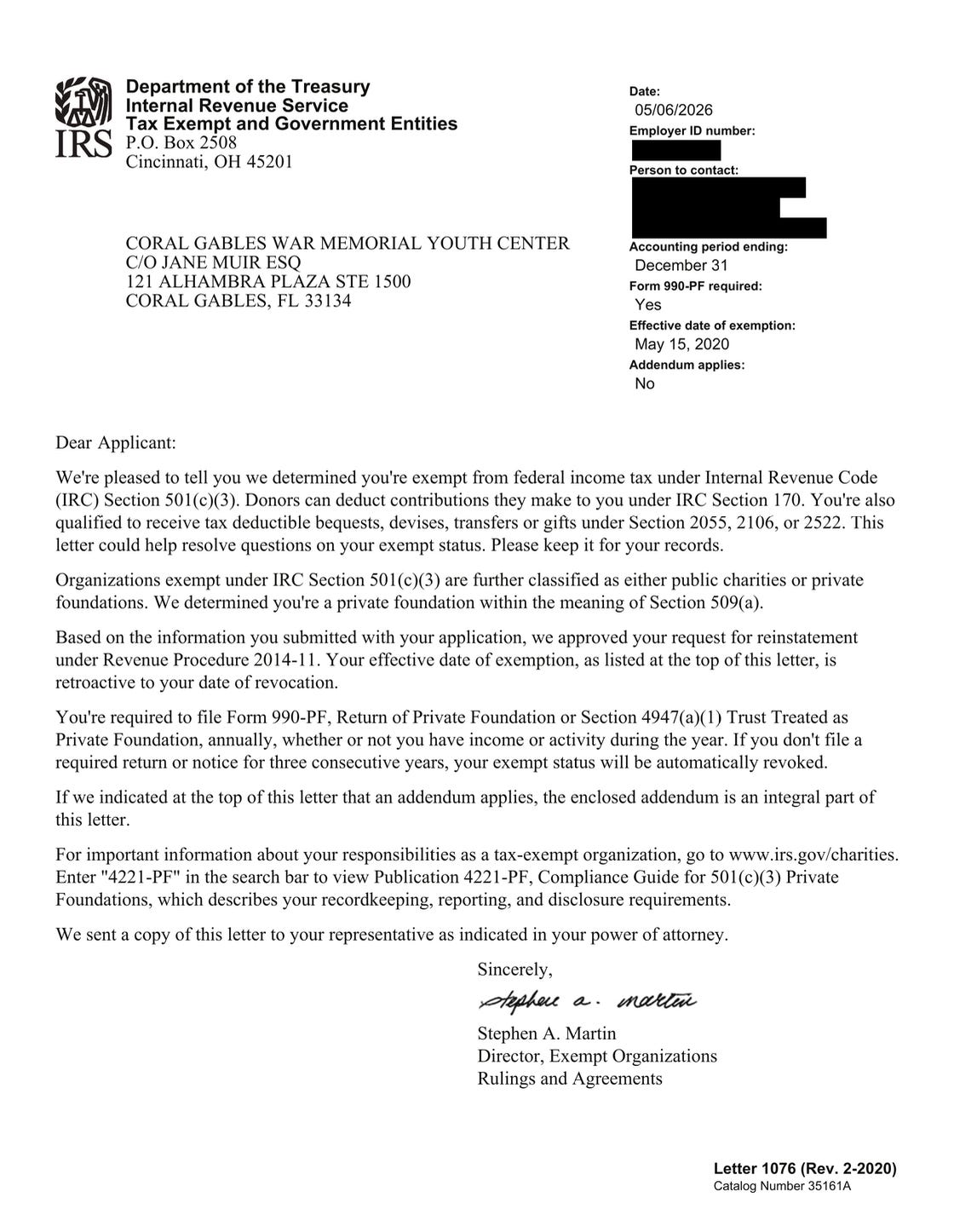
In July she published a long defense of the Association’s compliance. She catalogued every document the group has handed the City. She counted the letters she personally signed. And she never once mentioned the federal document sitting in her own office that restored her client’s exemption. Nobody forgets the best thing they own. There is only one reason not to lead with the letter that vindicates your client, and it is that you cannot explain what the IRS reinstated the Association to without saying what it reinstated it from.
Two of her points are correct, so let me dispose of them before they get in the way.
Yes, the May 15, 2020 effective date is retroactive to the date of revocation, which means that as a legal matter the gap is closed. No back taxes, and donations stayed deductible throughout. She is welcome to that. It changes nothing about how the gap got there, or what had to happen to close it, which is the entire story.
And yes, she is likely right that Florida’s public records law does not reach a private nonprofit like this one, and that the City may be spending outside-counsel money it won’t recover trying to force the records loose under Chapter 119. Fine. Note what that argument actually is. Her strongest point is not that the Association’s conduct was clean. It is that the public may have no legal right to see the proof either way. That is not a defense of the organization. It is a jurisdictional off-ramp, and she is right that it exists, which makes everything below worse, not better.
Because a reinstatement letter is not a gold star. It is what the IRS sends when an organization asks to be forgiven, and forgiveness requires something to forgive. This one says so in as many words: it approved a request for reinstatement under Revenue Procedure 2014-11, retroactive to the date of revocation. That procedure is not a formality. Exemption is revoked automatically when an organization fails to file for three consecutive years, and to undo that this far after the fact, the Association had to file every delinquent return and submit a signed statement establishing reasonable cause for those years. A private foundation, which the IRS confirms this is, does not qualify for the streamlined path available to smaller charities. One door, and a written explanation taped to it.
So a few things are no longer arguments. The returns were late. They were prepared and filed recently, in a batch, under the pressure of a reinstatement application. And reinstatement under that procedure is not granted unless an officer submits a signed statement establishing reasonable cause for each missed year. To obtain the letter Ms. Muir has been holding since May, in other words, someone at the Association had to put that explanation in writing and send it to Washington. It should therefore sit in the reinstatement file, alongside an exemption application that federal law opens to public inspection.
Which brings me to the sentence I keep coming back to. On August 26, 2025, Ms. Muir wrote to City Attorney Cristina Suarez that the documents she was enclosing reflected the Association’s “continued compliance” with its obligations under state and federal law. On that date, by the IRS’s own timeline, the Association’s exemption had been revoked for five years and three months, and would not be restored for another eight. Whatever that sentence describes, continued compliance is not the phrase for it.
And notice the words that never appear anywhere in her correspondence. Not “revoked.” Not “reinstated.” What you get instead is a discussion of a corporate lapse from the 1990s and a correct citation to the Florida statute forgiving it, a thirty-year-old state paperwork matter that nobody had raised. It is a very good answer to a question no one asked.
Let me step back, because it is easy to lose the thread in the paperwork, and Ms. Muir would prefer you did. Aesop’s argument was never that reverter clauses are illegitimate, or that this one is invalid. Reverters are ordinary and often sensible, and a court enforced this one in 1968. The argument has always been narrower and harder to wriggle out of: that the specific outfit holding this particular claim on a public building is no longer fit to hold it. Under Kirk Menendez, an organization that has held this claim since 1958 let its federal status lapse into revocation, went silent for years, registered itself to a private home on Malaga Avenue where three of its six listed officers also lived, and reduced its records to something the City has spent months trying to pry loose. The question was never whether a reverter can exist. It is whether a dormant nonprofit in that condition, one that had to petition the IRS for its life back, is the entity that should hold a contingent claim to the Coral Gables War Memorial Youth Center. The reinstatement letter does not answer that question. It sharpens it, because it confirms just how far gone the thing had gotten.
Here is the part that stuck with me. The reconstruction produced seven returns. Ms. Muir gave the City five. The two she withheld cover 2017 and 2018, which fall inside the three-year run of missed filings that triggers automatic revocation. Consider the mechanics for a second. Handing over all seven is one motion. Handing over five means someone removed two documents from a stack the accountants had already assembled. Leaving them out was more work than including them.
The returns she did produce carry their own tells. The 2021 filing authorization, Form 8879-TE, is unsigned, no officer signature, no preparer signature, no dates, on a form whose entire purpose is to record that an officer swore to the return under penalties of perjury, and which the preparer is required to keep. The 2023 return went in under a Hurricane Milton relief extension, filed on the January 2024 revision of Form 8868, which means a return originally due in the spring was still being handled sometime after the storm made landfall that October. These are not the artifacts of an organization that kept its books and simply forgot to mail them. They are the artifacts of a scramble.
I will say one thing about the money, and then leave it, because you do not need a forensic accountant to see the problem. By the Association’s own account, this is money professionally managed at Morgan Stanley. Yet over the roughly nine years covered by the very statement Kirk waved around at the candidate forum, its reported value barely moved, while the broad market over that same period more than doubled. Professional management through the strongest decade in living memory does not produce a flat line. I am not going to guess at why, because I do not have to. And notice what that statement actually showed: a value. What no one has produced, across months of letters, is the document showing the account’s activity over those years, the deposits, the withdrawals, the transfers. It generates itself. No one has to draft it. It would settle the question in either direction in about ninety seconds, which is presumably the problem.
So here is where we stand. For months, this newsletter and the City both asked the same simple thing of the Association: open the books. In his last piece, Aesop offered Ms. Muir an easier version still, just sign a statement vouching that the filings were made and the money was clean. It turns out such a statement should already exist. The letter now sitting in Ms. Muir’s office could not have been issued without one, which means an officer of the Association had to write it, sign it, and send it to Washington.
So the question is no longer whether the Association will explain itself. To obtain that letter, it already had to, to Washington. The question is whether the residents of Coral Gables, who own the building at the center of all this, get to read what was said about them, and whether the group that had to be resurrected by federal application is really the steward anyone would choose to hold a claim over that building. Federal law opens the reinstatement filing to public inspection. Ms. Muir, who keeps calling these filings available to anyone who asks, has already agreed in writing.
The record does speak for itself. Someone just had to read the part she left out.
After reading what feels like the latest installment of *War Memorial: The Director's Cut*, I think we've learned three things.
First, the Association has legitimate historical roots and the original donors had every right to protect their gift.
Second, the City's questions about governance, transparency, and compliance aren't frivolous either. An IRS reinstatement isn't a participation trophy—it means something had to be fixed.
And third, we're all becoming experts on paperwork from the Clinton administration while the Youth Center itself still needs a future.
Here's a crazy idea: instead of spending another year proving who made the bigger filing mistake twenty years ago, why not solve the problem permanently?
Record a binding covenant that runs with the land. Require that the property remain a War Memorial Youth Center dedicated to serving Coral Gables youth regardless of who owns it. Give both the City and the Association mutual reversion rights if either abandons that purpose. Better yet, allow independent third-party enforcement so neither a future Commission nor a future Association board can quietly decide the rules no longer apply.
If everyone truly believes the property should never become condos, offices, or the next "transformational mixed-use opportunity," then memorialize that promise in the deed instead of another newsletter.
Protect the purpose—not the personalities.
Because history is important. But it's an awfully expensive place to keep living.