
Finding Out
On reverters, referendums, and really bad excuses.

It’s confirmed. We’ve officially entered a new period of Gables politics. It’s called the ‘Finding Out’ period, which technically began after the most recent election and is marked by—you guessed it—a whole lot of finding out. It was directly preceded by the two-year ‘F***ing Around’ period, which began after the previous election. Naturally, these two periods combine to form a broader era called ‘F.A.F.O.’
For proof of this, look no further than last week’s 12-hour commission meeting, which produced so much well-deserved finding out that Ariel was once again compelled to play hooky. Predictably, though, the tyrannical minority is coping by dismissing this massive swing in the karmic pendulum as an unprovoked reign of terror, a case of the ruling coalition cruelly satisfying their sadistic appetites on KFC’s pain and suffering.
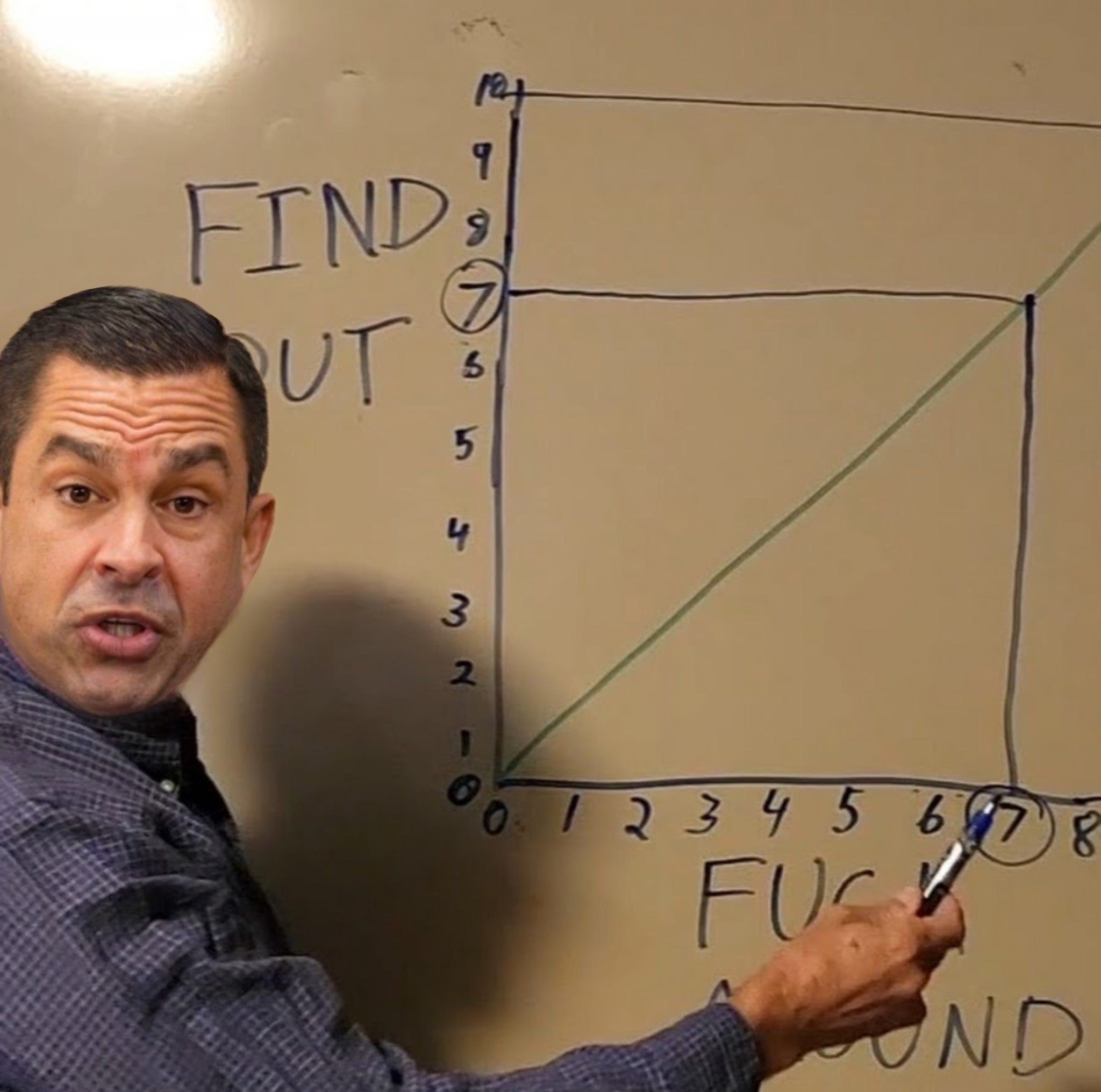
But I’m all about the Science, which shows that finding out is never random, but the inevitable output of a function where Finding Out is directly proportional to F***ing Around. In the simplest mathematical terms:
Finding Out = f(F***ing Around)
As someone who lived through two years of KFC’s weaponized dysfunction, I submit to you that there’s still an awful lot of F***ing Around that remains to be canceled out. Happily, the next commission meeting is less than a week away, which means that effort can soon resume.
Not so happily, however, Lago’s check got lost in the mail last week, which meant I had to go on a little strike, because business is business, amirite? That said, there’s almost nothing a bag of unmarked bills stashed under a dumpster behind Hillstone can’t fix, and so I’m happy to report that I’m back in the saddle. Kudos to the mayor for having a plan B.
Oh come now, I’m only kidding. 😝
Or am I? 🤨
In any event, I’m a little short on time, so all I have for you today is a culled selection of notes from the last meeting, focusing mainly on a couple of major set pieces. There’s no real narrative flow or continuity here, nothing depends on what came before, which, on the bright side, means you can skip straight to whatever topic interests you without missing a beat. Am I phoning it in a bit? Yeah, but with luck you’ll still find an idea or two worthy of reflection.
At the youth center of controversy
The city attorney updated the commission on her recent efforts to obtain a host of records from the War Memorial Youth Center Association Inc. (WMYCA), the Kirk Menendez–run nonprofit that in the 1950s deeded the Youth Center property to the City, subject to a reverter clause returning ownership to the WMYCA if the City violates the terms. It’s a complicated issue brimming with suspicion and intrigue, one I’ve already analyzed in some detail here, here, and here. According to the City attorney, the WMYCA (read: Kirk) was unresponsive and blew past the City’s August 18 turnover deadline, eventually coughing up a limited set of records only shortly before last week’s commission meeting. Even then, the records provided were incomplete, and so the commission (with Dr. Castro dissenting) directed the city attorney to engage outside counsel to pursue the matter further.
Notes:
There seems to be a widespread impression among WMYCA’s defenders that the A.L.L, two of whom are attorneys, don’t comprehend Florida’s public records laws. The refrain goes something like: “The WMYCA is a private entity, therefore it doesn’t need to respond to a public records request, duh.” If only it were that simple. I devoted an entire post back in March to explaining why the WMYCA could very well fall under the scope of Florida’s public records laws. These people might want to try engaging with an argument before glibly dismissing it.
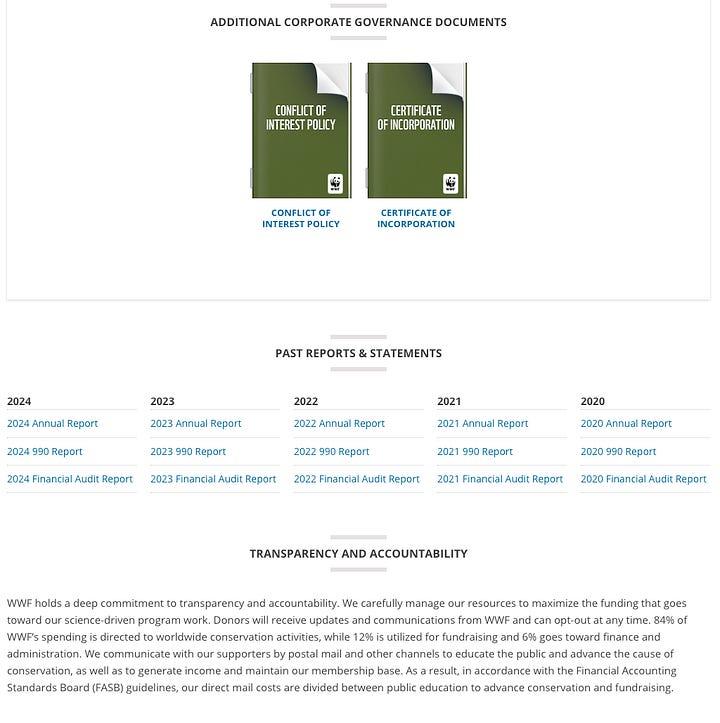
Not enough has been said about Kirk’s dubious intransigence on the records issue. Any thinking person knows that the suspicions surrounding his management of the WMYCA and its assets are more than reasonable, thanks in no small part to his own conduct both before and after this issue came to light. Even absent suspicion of wrongdoing, it is standard practice for nonprofits and charities to make their financials accessible to the public. The American Red Cross, for example, voluntarily posts on its website audited statements going back years. The World Wildlife Fund does the same. Yet here we have Kirk, after letting the WMYCA land on the IRS auto-revocation list and appointing his wife and daughter as treasurer and vice-treasurer, acting as though a request for basic records was some kind of outrageous intrusion. As if the WMYCA were the real KFC being asked to hand over its secret blend of 11 herbs and spices.
The problem isn’t so much with a reverter clause, but with this reverter clause. More to the point, it’s the entity the property would revert to. This may sound crazy, but some of us aren’t fully on board with the idea that the best way to “protect” the Youth Center is to pretend the safest course is to never question a potentially expired contingent ownership claim held by an organization run by Kirk Menendez, the same guy who ran the Miami Sports and Exhibition Authority into the ground through sheer incompetence, if not worse. Lago’s question to the stumped Dr. Castro about judicial receivership suggests to me that he’s open to maintaining the reverter, but only if the property were to revert to a responsible party like a court or a legitimate nonprofit. You know, one that actually operates with integrity.
One reason why the reverter may be invalid is that the WMYCA was administratively dissolved by the State in 1992 and reinstated in 1996, four years later. Now, according to F.S. 607.1421, which governs dissolution, “a corporation administratively dissolved continues its corporate existence but may not carry on any business except that necessary to wind up and liquidate its business and affairs.” This, along with a principle called ‘relation-back,’ allows for a reinstated corporation to relate back to the effective date of the administrative dissolution and “resume carrying on its business as if the administrative dissolution had never occurred.”
Moreover, per 607.1421, a corporation does not surrender title to its properties by virtue of its dissolution. All of this is good for the WMYCA and its reverter.
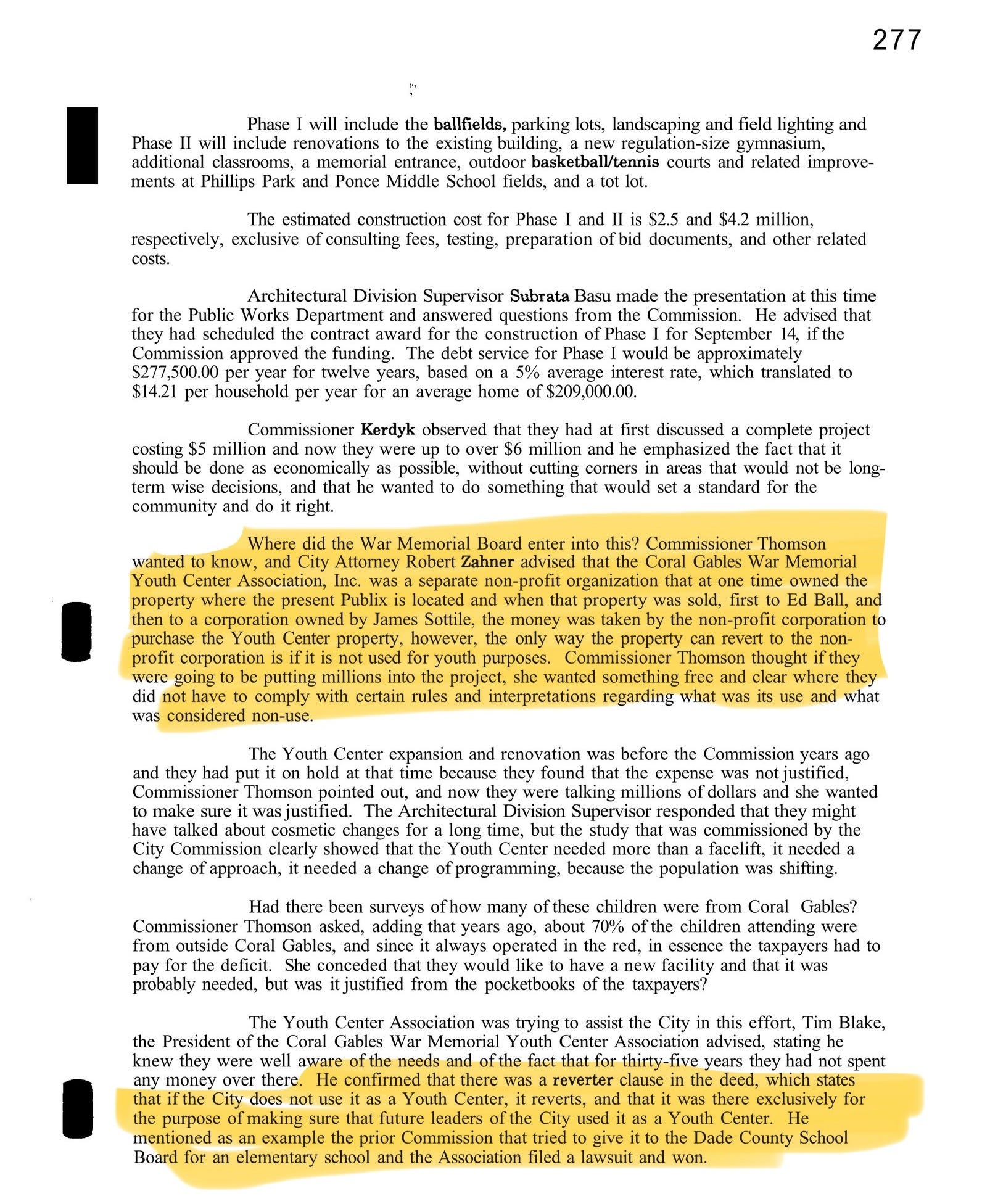
Here’s the bad part: the WMYCA doesn’t enjoy title to the Youth Center property, rather it holds only a contingent ownership claim by virtue of a condition-subsequent reverter. In other words, something has to happen to trigger the reverter, and the WMYCA has to be around to do something about it. The WMYCA wasn’t around between 1992 and 1996, and that gap creates a potentially fatal uncertainty about the continuity of the right. Worse still, it wasn’t merely idle on the sidelines during this period of dissolution, it was actually named in a 1993 resolution as a coauthor of Youth Center guidelines. That means the WMYCA was carrying on business well beyond the “wind up and liquidate” scope allowed by statute by exerting influence over the very property tied to its reverter while legally incapacitated. To make matters worse, here is a portion of the transcript from a 1993 commission meeting (a year after the WMYCA was dissolved) in which the president of the WMYCA is participating on behalf of his nonexistent association on an item contemplating major enhancements to the facility. See the final paragraph in particular:
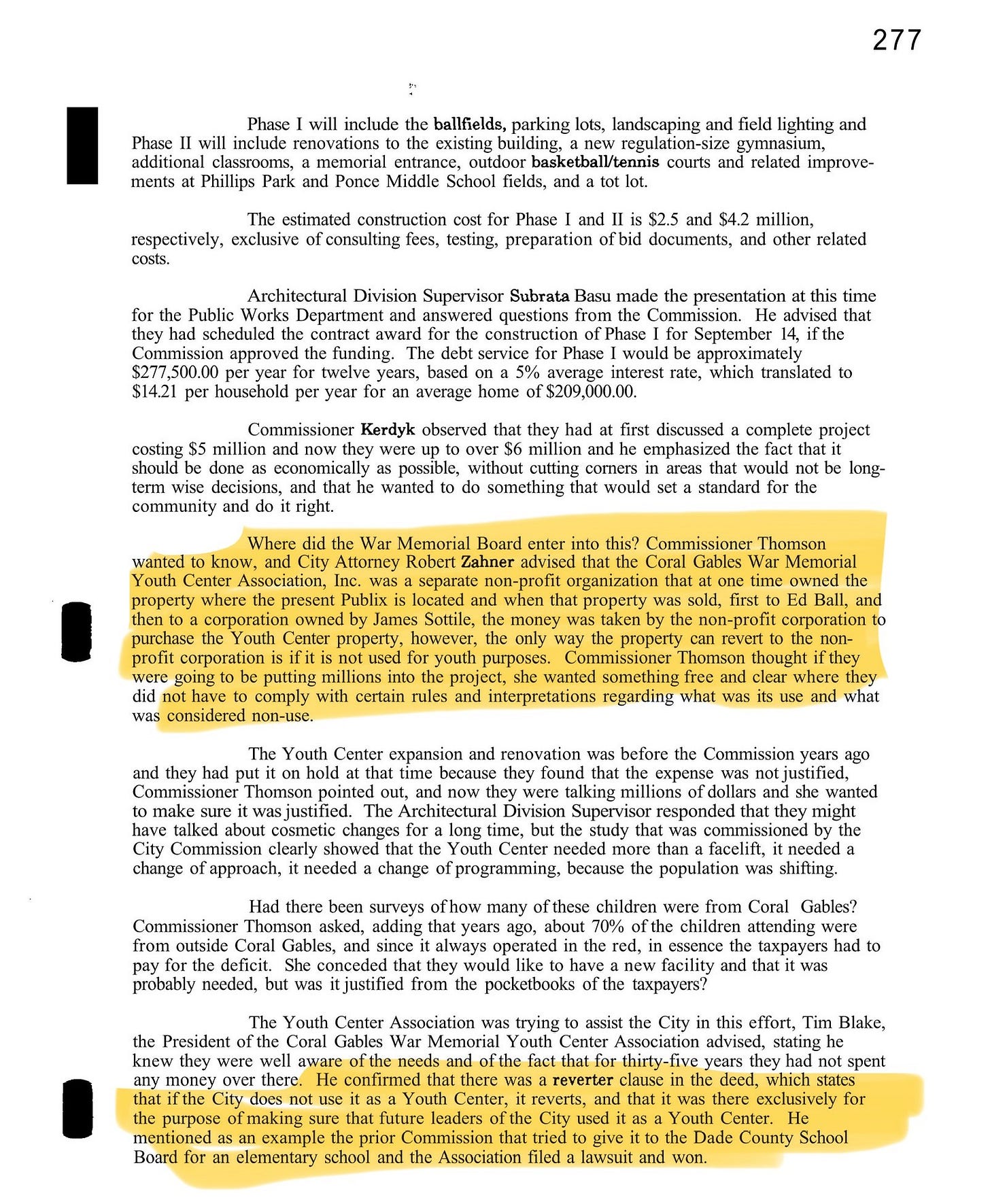
What other forms of influence did it exert while dissolved? And how do we know that any future claim it makes won’t trace back, in proximate-cause fashion, to actions taken while it had no standing to act but while it nonetheless meddled in Youth Center affairs? On top of that, when the WMYCA finally came back in 1996 it did so only after the State forced it to reconstitute as an “Inc.” and with a heavily amended charter that materially changed its nature, most notably by adding 501(c)(3) restrictions it never had before and that were never mentioned in the 1958 deed. Therefore we must question whether this is even the same entity the deed contemplated or a new one trying to inherit a right it was never granted.
A different meddling argument, by the way, applies to Kirk himself, who filled two conflicting roles during his four years as commissioner. One as the president of an organization that stands to inherit the Youth Center property should the City violate the reverter’s conditions, and the other as a commissioner with substantial material influence over that same property. What does this say about the $100 million+ parks and recreation bond package (much of it for the Youth Center) that he advocated for so passionately while in office? What else was Kirk up to behind the scenes? Do we have a potential unclean hands problem here?
Even setting aside the dissolution gap and Kirk’s four years of textbook conflict of interest, what about the WMYCA’s more recent troubles? Is it even a valid entity at this point? By its own charter, it must operate under the same restrictions as a 501(c)(3), which means filing returns, holding regular meetings, keeping minutes, and maintaining basic transparency. Yet it appears to have done none of these things. Is the WMYCA not, therefore, in violation of its own charter? Is it not perhaps ripe for dissolution once again?
One thing that has thus far been missing from this analysis is something called MRTA, or the Marketable Record Title Act, which could be yet another reason the reverter is no longer valid. Very roughly speaking, MRTA requires that property interests be renewed or recorded within a certain period or they’re considered extinguished. Governments are typically exempt from this, but that exemption likely doesn’t apply here, as the City is the grantee, not the grantor. I’m no MRTA expert, and I’m not sure whether it truly applies here, but it’s an interesting angle. Any experts are welcome to chime in.
Let’s close this out with an unpleasant thought experiment, as principles are often easier to identify at the extremes. Imagine the reverter weren’t held by the WMYCA but by an organization later exposed as a massive child sex–trafficking ring. Imagine that this is established beyond any reasonable doubt. Would you still insist “a reverter is a reverter, there’s nothing you can do”? Or would you expect the City, and a court, to find a way to quash or modify it so that such a group could never inherit public property? Does anyone really believe a judge would let that transfer go through? We all know the answer.
Now let’s take the thought experiment a step further. Suppose it wasn’t proven beyond doubt, but there was mounting circumstantial evidence, like children disappearing after last being seen near the group’s offices and neighbors hearing cries from the basement, and when asked to open the basement for inspection the organization refused, waving it off with “we’re private, we don’t have to.” Would anyone accept that answer? Or would the refusal itself only deepen the suspicion?
That’s essentially the dynamic here. No one’s suggesting the WMYCA is hiding a secret quite so heinous, but the principle remains the same. The WMYCA is supposed to be a nonprofit carrying out a noble mission for the community, and like most legitimate nonprofits it has a basic ethical duty to operate with full candor and transparency. Yet here it is, flouting even the most minimal standards of openness, and doing so against the backdrop of troubling facts we already know, while behaving as though it were being asked to reveal proprietary trade secrets. We don’t know the full extent of its misconduct, whether it’s merely been sloppy or something worse, but we do know that any organization can behave badly enough to forfeit a contingent property right as a matter of both principle and law. No such right is absolute.
Which brings us back to reality. The legitimacy of the entity on the receiving end of a reverter matters, and both law and common sense recognize that unfit entities can be stripped of contingent rights. Moreover, the City has a right to know what it can and cannot do with its own property—regardless of whether it intends to do anything at all. A reverter hanging over the title radically narrows the menu of options available, and the viability of the WMYCA goes directly to the validity of that reverter. The City is therefore entitled to the information it seeks and shouldn’t have to go to court to get it. At a bare minimum, the City and the public have every right to scrutinize whether an organization that has gone out of its way to delegitimize itself should still be treated as the lawful holder of a reverter potentially worth tens of millions of dollars.


April vs. November…still
Dr. Castro and Lago had competing items on the agenda for this. Castro wanted a referendum question placed on the November 2026 midterm-election ballot, while Lago (as did the rest of the A.L.L coalition) wanted the question put to the public via a special mail-in-ballot referendum to be held in April 2026. Lago’s option won out, of course, with Anderson tacking on a few extra questions for good measure, including one on engaging an inspector general (excellent idea). This all stemmed from recent uncertainty regarding the viability of the change-by-ordinance route taken by the commission several months ago.
Disclaimer: I wrote the first bullet before hearing the somewhat predictable news that Miami’s attempt at a redo with the 3rd DCA failed. I’m keeping it in, though, because the analysis was sound at the time.
Notes:
I suspect Dr. Castro is right on the central legal question. If so, she’ll have been right much the same way Punxsutawney Phil is right about the length of winter—that is, purely by chance, for we all know the doctor understands the law about as well as a groundhog understands climatology. Many on the pro-ordinance side seem to think the Miami case is distinguished from ours by virtue of Miami extending the current commission’s terms versus Coral Gables shortening theirs—not so. This is irrelevant to the central question, which is, at bottom, one of legal hierarchy. What’s more, the doctor never once questioned the viability of the ordinance when it was first passed. Her argument then was normative, not legal (i.e., we shouldn’t do this, not we can’t). She had no idea the Attorney General would throw a wrench into all this by wading into the Miami affair—because no one did (why he did is an interesting inside-baseball story, by the way). That makes the already ridiculous finger-wagging she’s now doing at colleagues for wantonly “breaking the law” all the more disingenuous.
They say never attribute to malice that which can be explained by stupidity, but I’ve learned that anything Dr. Castro does should be attributed to both. Everyone knows she wants a November 2026 referendum because, obviously, it precludes a November 2026 municipal re-election that would otherwise cut her 15 minutes of fame short. And everyone knows A.L.L wants an April 2026 ballot initiative for the mirror-image reason. The problem is the doctor pushed essentially all her rhetorical chips into the cost bucket, arguing that a November referendum is cheaper than Lago’s $77K April ballot initiative. But her approach guarantees at least one more April election, to the tune of roughly $150K. Lago’s approach spends $77K to save $150K, a concept the good doctor genuinely had difficulty grasping. The only way Lago’s cost analysis fails is if the referendum itself fails, which both sides know it won’t, which is precisely why KFC always fought having a referendum tooth and nail. The cost argument was one the doctor never fully grasped, and it wasn’t her strongest option anyway.
A better argument would have sounded something like this: “All this time, mayor, you’ve been waxing poetic about the democracy-boosting power of November elections—the massive turnout, the broader enfranchisement, etc. So why not have your referendum then? Sure, it means one more April election, but it settles the question once and for all, not only cheaply, but with democratic participation guaranteed to be higher than anything you could hope for in April, and with the very same voters you insist should be included in every election henceforth.” This argument isn’t flawless, but it’s miles better than claiming “mine cost less” when a) it doesn’t and b) the person making that claim is arguably the most reckless spender ever to sit on the dais.
The elephant not in the room
There’s so much more from this meeting worth discussing, most notably the well-deserved removal of Sue Kawalerski from the PZB and the copy-and-paste protestations it elicited from the whopping seven people upset by it. But Sue is really just a minor manifestation of a much deeper problem, one I’ve written about often over the years and will no doubt have to again.
It just wouldn’t be right to end this post without addressing the elephant not in the room, so to speak: Ariel’s continued absence from commission meetings. Indeed, for the third meeting in a row, the world’s hardest working public servant ran into yet another improbable obstacle that prevented him from showing up—even if only remotely—to the only job he has. This time, it was “limited connectivity” while allegedly attending a family engagement abroad, the same limited connectivity that struck Ariel at his home in the North Gables just weeks prior. Some luck.
But the oddest part about this last excuse is the timing, which Ariel delivered last-minute via an e-blast just before the start of the meeting, as if to suggest he’d only just realized he wasn’t going to make the meeting. The thing is, he also canceled his pre-agenda meeting with staff—a critical prep session held the week before a commission meeting—the week before, which strongly suggests Ariel knew he would not be attending the meeting as early as four days prior. So why the 11th-hour email as if his being indisposed was a last-minute development? And one can’t help but notice that despite this connectivity issue, he was still able to access his Mailchimp account and all the cheesy templates and graphics he uses in his communications. I guess his connectivity wasn’t that limited.
It’s gotten almost too ridiculous, to the point where I think the recall process may actually be more onerous than it should be. To think that short of resignation or removal, we might have to wait until the next election to rid ourselves of this embarrassment, even with this absurd dereliction of duty stacked on top of incontrovertible evidence of more than two years of fraud, itself preceded by at least one episode of legally dubious political scheming.
Many are attributing Ariel’s self-imposed exile to a sense of overwhelming shame, as if Ariel being about as visible as Osama Bin Laden was after 9/11 is part of some strategy to avoid further embarrassment. And while there may be some truth to this, I don’t think it’s the main driver.
If Ariel has shown us anything it’s that he’s practically immune to shame. How many bald-faced lies has he told over the years without compunction? How much dignity-shredding embarrassment have we witnessed him simply swat away from his conscience like some kind of gnat? Is there such a thing as rapid-onset dignity striking someone in their mid-forties?
Political Crisis Management 101 holds that when you're rocked by a scandal like this, you do the exact opposite of what Ariel is doing. You become more visible, not less. More committed to doing the people's work despite these "petty distractions." You proclaim your innocence, if only implicitly, and almost mock the very idea of taking any of it seriously. You demonstrate that you have nothing to be afraid of because you've done nothing wrong.
Ariel, of all people, understands this. Which is why until now he has leaned into every political mistake he's ever made, from the salaries to the manager debacle. Remember Ariel's shameless standing ovation for Peter Iglesias as he triumphantly returned to the dais after being reappointed? That's the Ariel we've come to know.
The fact that Ariel has gone in the opposite direction this time tells us there's a competing damage-control strategy at play. This isn't a purely political scandal, so the political playbook doesn't apply. It's a scandal involving potential criminal conduct, which means there's a legal strategy to consider. One that overrides the political one.
The legal strategy is as simple as it is obvious: shut the f’ up. Say nothing, do nothing. Avoid going on the record for as long as possible to minimize the potential for self-incrimination. Crawl into a hole, stay there until you absolutely have to emerge, and hope it all blows over through lack of prosecution or divine intervention.
This is why Ariel's political response has been so disastrously ineffective. He can't have his cake and eat it too, and when political necessities clash with legal ones, the latter always wins.
I suspect Ariel indeed will turn up at the next meeting. He has to. There’s no running out the clock on an active investigation. But make no mistake, his silence has already spoken volumes. His actions scream, “yeah, this is the end for me.”
All that’s left to know is how and when this will all end. And know we shall, for after all, these are the days of finding out.
After years of dysfunction, the last election finally cracked open the door to fixing Coral Gables politics—but what’s spilled out since has been less “orderly transition” and more “dumpster fire clean-up in progress.” Kirk Menendez treats transparency like a toddler treats broccoli, Dr. Castro proves that logic and math are optional electives, and the whole circus drags on longer than an Aesop fable with a TED Talk add-on.
Let’s start with Kirk, who apparently thinks running a nonprofit means handing the keys to his wife and daughter, skipping IRS filings, and clutching public records like they’re the Colonel’s 11 herbs and spices. Forget best practices—Kirk’s model for nonprofit governance seems to be “deny everything until someone brings outside counsel.” Inspiring stuff. Nothing says “trust me with millions in public assets” quite like pretending a reverter clause is holy scripture while you simultaneously run the Miami Sports and Exhibition Authority straight into the ground. Bravo, sir.
Then we have Dr. Castro, who continues her noble crusade to prove that the laws of basic arithmetic are cruelly misunderstood. Watching her argue referendum costs is like watching someone insist a credit card balance goes down if you just stop opening the statement. Lago explains that $77K now prevents $150K later, and Castro responds with all the conviction of a groundhog predicting spring. Truly groundbreaking legal analysis—if your ground school is run by Punxsutawney Phil.
And Aesop—poor Aesop. If brevity is the soul of wit, then this meeting was a soulless slog through allegories nobody asked for. Somewhere between the dissolution arguments, charter rewrites, and reverter clause theology, I half-expected a talking tortoise to stroll in and demand equal time on the agenda. At least Aesop, bless him (or her?), knew how to land the moral before his audience slipped into a coma.
At this point, the City’s biggest challenge isn’t just the corruption, the conflicts of interest, or the selective amnesia about Florida statutes—it’s surviving another commission meeting without collapsing under the weight of its own verbosity. Because if we keep this up, the real moral will be: those who F*** around not only find out, they make the rest of us sit through 12-hour lectures while they do it.
Today I learned that, notwithstanding the Fifth and Fourteenth Amendments, I can be “stripped” of my property rights if I am deemed “unfit.”