
Crazy Expensive

To understand politics, one must first understand people. And in the Gables, few are harder to understand than Maria Cruz—better known to most readers as Mrs. Cruzchev. For newcomers, the backstory to that moniker lives here. But if you’re too busy to spend time reading an old post, worry not, for sometimes a picture really is worth a thousand words.
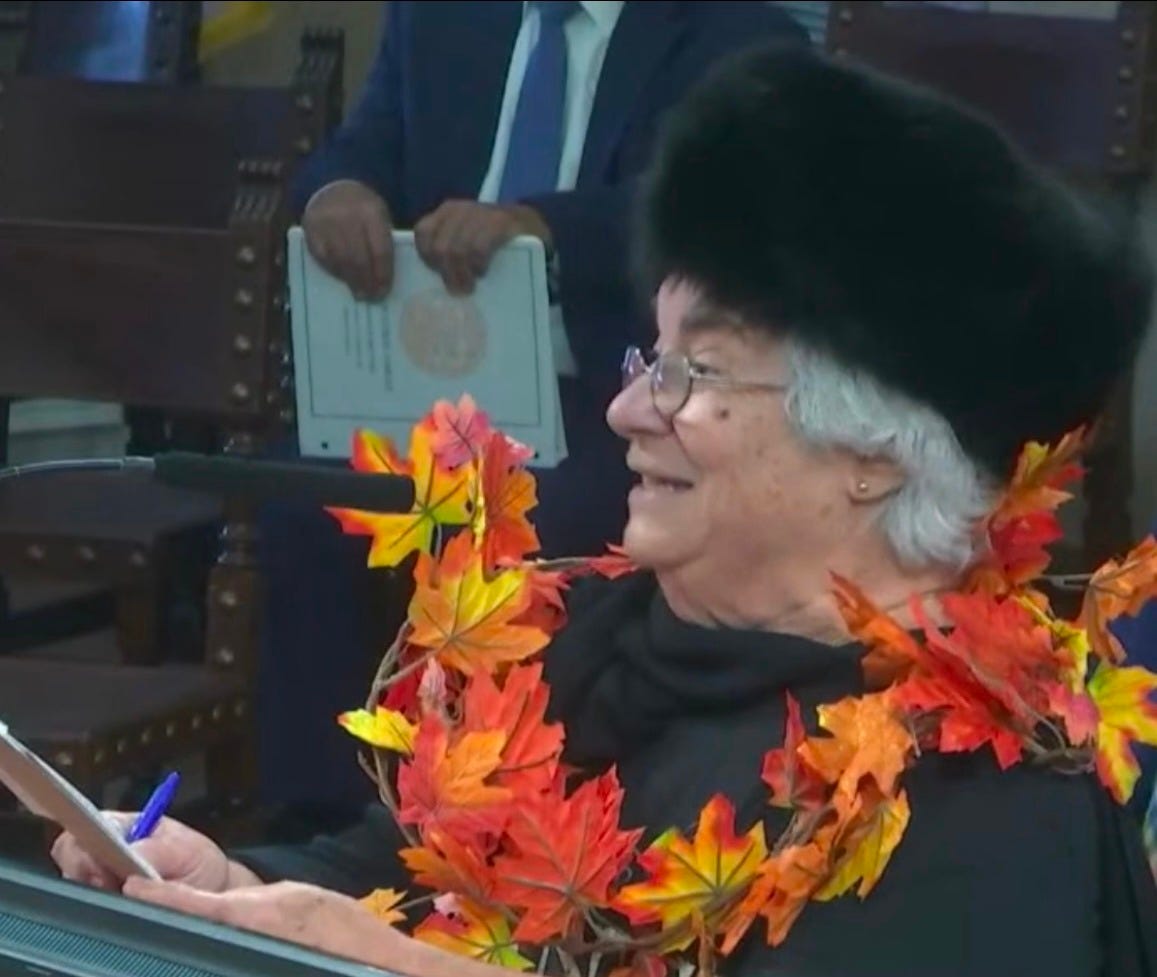
That’s her good side, by the way. I mean that both literally and figuratively, as Mrs. Cruzchev is nothing if not a layered personality, which is precisely what makes her so tricky to deconstruct.
On the surface you’ll find an elderly-widow-cum-local-gadfly with a penchant for cheesy performance art and flair for the melodramatic, a decidedly unserious character who ultimately is as harmless as she is omnipresent. Does she sometimes cross the line? Sure, just like grandpa crosses the line when he tells the 23-year-old Macaroni Grill server that he wishes she were on the menu. The filter simply stops functioning at a certain age. Whaddya gonna do? 🤷♀️
As such, it’s tempting to dismiss—as I often have—Mrs. Cruzchev as KFC’s unwitting cipher, an obnoxious but ultimately irrelevant agitator, the court jester who doesn’t realize she’s the court jester. It’s perfectly natural for one to attend the incoherent rantings of this plaque-brained, noxious gasbag and conclude that, while irritating, they’re nonetheless a small price to pay for an open and accessible government and a healthy First Amendment.
But look more closely and you’ll notice something more substantial. You’ll see that rather than orbit KFC’s chaos like some kind of senescent groupie, Mrs. Cruzchev often serves as the axis around which it spins. The best example of this was the unprecedented and incompetent recall campaign against Lago, which not only failed, but led to an FDLE investigation that rumor has it will soon result in several arrests. Mrs. Cruzchev, you’ll remember, was the chairwoman of the recall committee, the Big Jefa, the nominal chief executive of an operation that enlisted, among other model citizens, a canvassing chief who was recently convicted of healthcare and wire fraud.
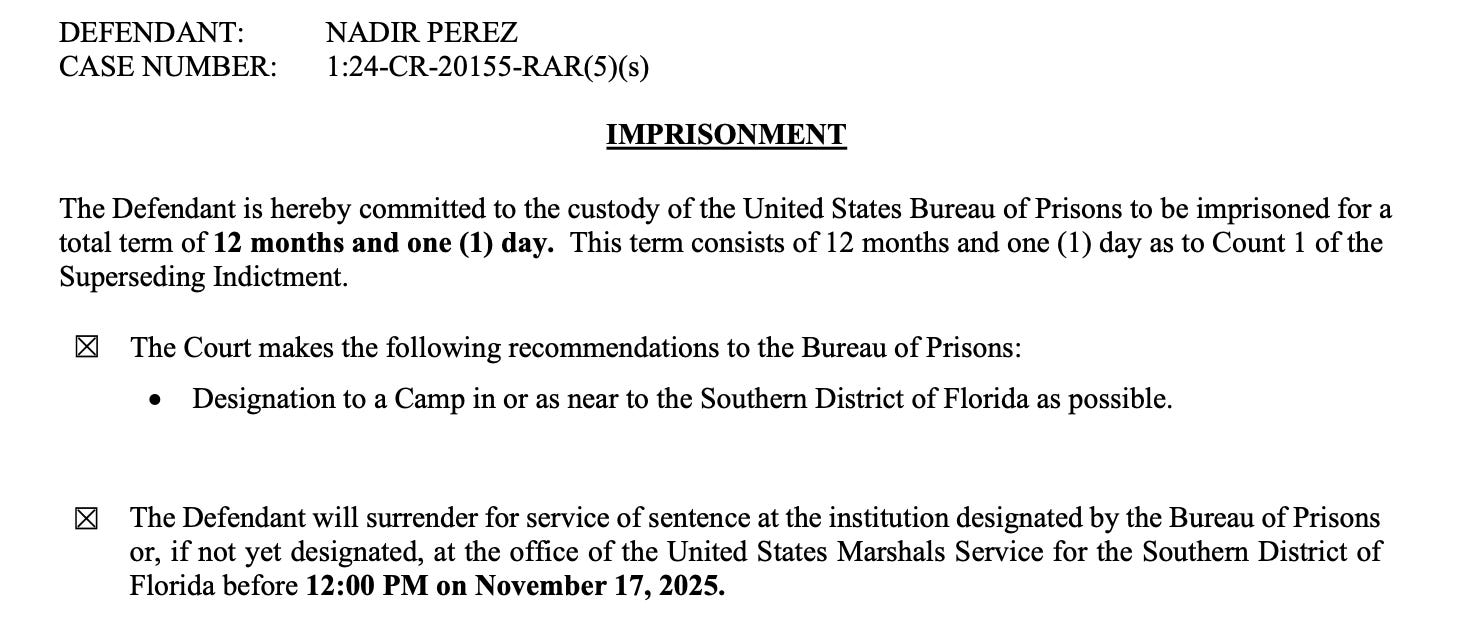
And when she’s not at the center of a coordinated hit-job, she’s at the vanguard. Take, for instance, the p-card scandal that fizzled and the despicable October-surprise attack on the mayor’s personal life last Spring. In both cases, Mrs. Cruzchev served as the tip of the spear, swooping in to soften the ground with public-comment monologues that underneath the thick layer of batshit ended up foreshadowing impending scandals with remarkable prescience—almost as if she were aware of supposedly organic developments ahead of time.
Yet for all the scheming and coordination, there’s a final layer that is undoubtedly the most troubling. It’s a layer that reveals a figure that’s even more problematic than a clinically bored and obnoxious busybody with an insatiable appetite for political skullduggery. It reveals, in fact, someone who is either so tragically deluded that she requires immediate psychiatric care, or someone so cynical and conniving that she’s willing to feign psychological instability in a clumsy bid for sympathy and attention. Either way, it’s long past the point of being harmless or self-contained. Her delusions, real or not, have spilled into the public realm, eroding civic discourse through an endless stream of unhinged tirades while imposing real and mounting costs on taxpayers forced to fund the investigation of her increasingly paranoid fantasies.
Case in point: the practically permanent watch order Mrs. Cruzchev maintains on her house. I first wrote about this in 2024, but for the life of me I can’t remember where. Anyway, for the uninitiated, a watch order is essentially a directive to patrol officers instructing them to conduct extra checks on a specific residence. It’s typically reserved for people who will be away from their homes for an extended period, or for homes that face credible, documented threats, not as a concierge security service for paranoid gadflies.
As I discovered long ago, Mrs. Cruzchev, who prides herself on being blunt and honest, had uncharacteristically vague justifications listed in her watch orders, to wit: “verbal threats” and “people tell me I need to be careful” and most perplexingly “increased patrol.” That’s essentially it. No specifics. No names. No actual threat. Just a cryptic non-explanation that somehow resulted in months upon months of personalized police check-ins on her home and person, as if she were in imminent and permanent danger.
But danger from what? Or rather, from whom?
We now know the answer, straight from the demented horse’s mouth no less, thanks to this candid little exchange she had with Coral Gables’ finest on the morning of June 1st, after she called police to report an encounter with a man who had approached and then entered her car asking for a ride and to use her phone. The man, who said something unintelligible before walking away, turned out to be a burglar who had just hit a house down the street.
Did you catch that? She received a watch order because she has “issues with the mayor” and because “he’s a little crazy.”
Yeah, she has issues alright.
I have issues, too. Issues with my tax dollars being wasted on perpetual personalized police protection for a delusional crank who thinks she’s dodging mayoral hit squads.
But before exploring how egregiously wasteful and unfair these watch orders are, can we first just take a moment to reflect on the 140 decibels of meowing in the background and how it confirms that Mrs. Cruzchev is literally the proverbial Crazy Cat Lady? And can we also pause to appreciate that gorgeous and impeccably tasteful mildew-accented carport that I’m sure is totally code compliant? Isn’t it reassuring to know that the self-appointed champion and sworn defender of the ‘City Beautiful’ understands that beauty, like charity, starts at home, and that her Sanford and Son-esque architectural beauty standards are every bit as exacting as her personal ones?
Anyway, back to those watch orders, because it’s important that you understand just how much of a drain this one person is on municipal resources. Here is a list of all police events associated with Mrs. Cruzchev’s address over the last year and a half alone—all 640 of them! And note that this doesn’t even include the Neighborhood Safety Aides who practically lived at Mrs. Cruzchev’s house during the same period, since technically they’re not police department employees. Nevertheless, it’s nothing short of epic:
Allow me to unpack what you just saw. Each row represents a unique police visit to Mrs. Cruzchev’s home. Per column D, event origin, approximately 93% of those visits were the direct result of the infamous crazy-mayor-is-out-to-get-me watch order that for some bizarre reason the City dutifully fulfills. Over in column L, job time minutes, you’ll see the time consumed by each call, which all total comes out to approximately 140 hours!
Let me repeat that. Between April 2024 and September 2025, the Coral Gables Police Department burned 140 hours humoring a delusional elderly rabble-rouser who thinks—or at least pretends to think—she’s the target of an elaborate criminal vendetta emanating from the mayor’s office. Mind you, this is the same woman who seems to think that occasionally being addressed as Ms. instead of Mrs. essentially rises to the level of a civil rights violation.
Of course, we’re not living in the 17th century and so law enforcement is no longer conducted by local volunteers but by taxpayer-funded departments staffed with well-compensated professionals. So what does 140 hours of police time actually cost? Factoring in wages, benefits, vehicles, equipment, dispatch operations, and administrative overhead, the fully loaded hourly cost of a single on-duty officer typically falls somewhere between $100 and $200 per hour in most U.S. cities, and it’s often higher in affluent municipalities like Coral Gables. And because nearly all of these calls involved two officers (as shown in the “Primary Officers” column), the true expenditure likely doubles.
That means those 140 hours translate to roughly 280 officer-hours, at a conservative blended rate of $150 per hour. The math is straightforward:
280 hours × $150/hour = $42,000
Good grief. For that we could have given away another taxpayer-funded no-questions-asked wheelchair ramp to a private theatre company! Instead we blew the whole amount effectively enabling one person’s chronic paranoia simply because no one is willing to incur that endless wrath that results from telling this vindictive malcontent ‘No!’
Now here’s an interesting thought: governments aren’t supposed to hand out services like party favors—one for you, none for me—depending on who complains the loudest. Under the Equal Protection Clause, if one citizen receives a government service, another who meets the same objective criteria is, in principle, entitled to the same. And since Mrs. Cruzchev seems to have secured multiple watch orders on the basis of undocumented threats and nothing more than her own vague sense of peril, does that not set the standard for the rest of us?
If I, a Coral Gables resident, were to wake up tomorrow convinced that someone (perhaps Mrs. Cruzchev herself, because why not?) was plotting to harm my person or property, wouldn’t I be equally entitled to 140 hours of police attention? Wouldn’t you? Wouldn’t every one of the city’s 50,000 residents? Because if that’s the new threshold—‘I just feel like someone is out to get me’—then the Coral Gables Police Department might want to start looking for that extra $2.5 billion lying around in its budget, as that’s approximately what it would need to provide the same level of service to everyone else.
Of course, the very notion is absurd, which is precisely the point. But it’s absurd only because the City has extended to one individual a level of service it could never reasonably provide to dozens, much less thousands, of others. If it tried, the system would collapse under its own inefficiency. Which is why most cities apply a reasonable evidentiary threshold before devoting substantial taxpayer resources to personal paranoia. For reasons known only to Coral Gables, that threshold apparently does not apply to Mrs. Cruzchev.
I’ll close by returning to the opening idea, i.e. that making sense of Mrs. Cruzchev is harder than it looks. On one hand, there’s a long history of behavior suggesting she’s genuinely unhinged. You have the incoherent rants, the clownish costumes and custom t-shirts, the pathological narcissism, the apparent delusion that she’s the persecuted heroine of some political thriller in which a mid-sized city mayor commands shadowy forces bent on her destruction but perpetually thwarted by her cunning. It all screams ‘I’m permanently out to lunch.’
On the other hand, there’s an equally substantial record suggesting she’s anything but. She’s been consistently positioned at the center of coordinated political attacks on Lago, tapped for appointments to powerful boards like Code Enforcement, and chosen as the public face and chairwoman of a well-funded recall campaign. That’s hardly the resume of a senile groupie stumbling through local politics. No, it reads much more like the resume of a political operator, someone trusted with real responsibility, someone who has to be sufficiently grounded and lucid to execute the roles she’s been assigned.
So which is it? Is Mrs. Cruzchev crazy, or crazy like a fox? I’m not quite sure, though I suspect it’s a little bit of both. What I do know is this: she’s loud, obnoxious, and vile—she once told Lago’s wife that she “hopes her husband kills himself like Sergio Pino did.” Worse still, she has a knack for making other people’s money disappear, whether it’s the stolen booster-club funds that ended her career as a public school teacher or the tax dollars being squandered in service of her delusion that she’s important enough to warrant protection.
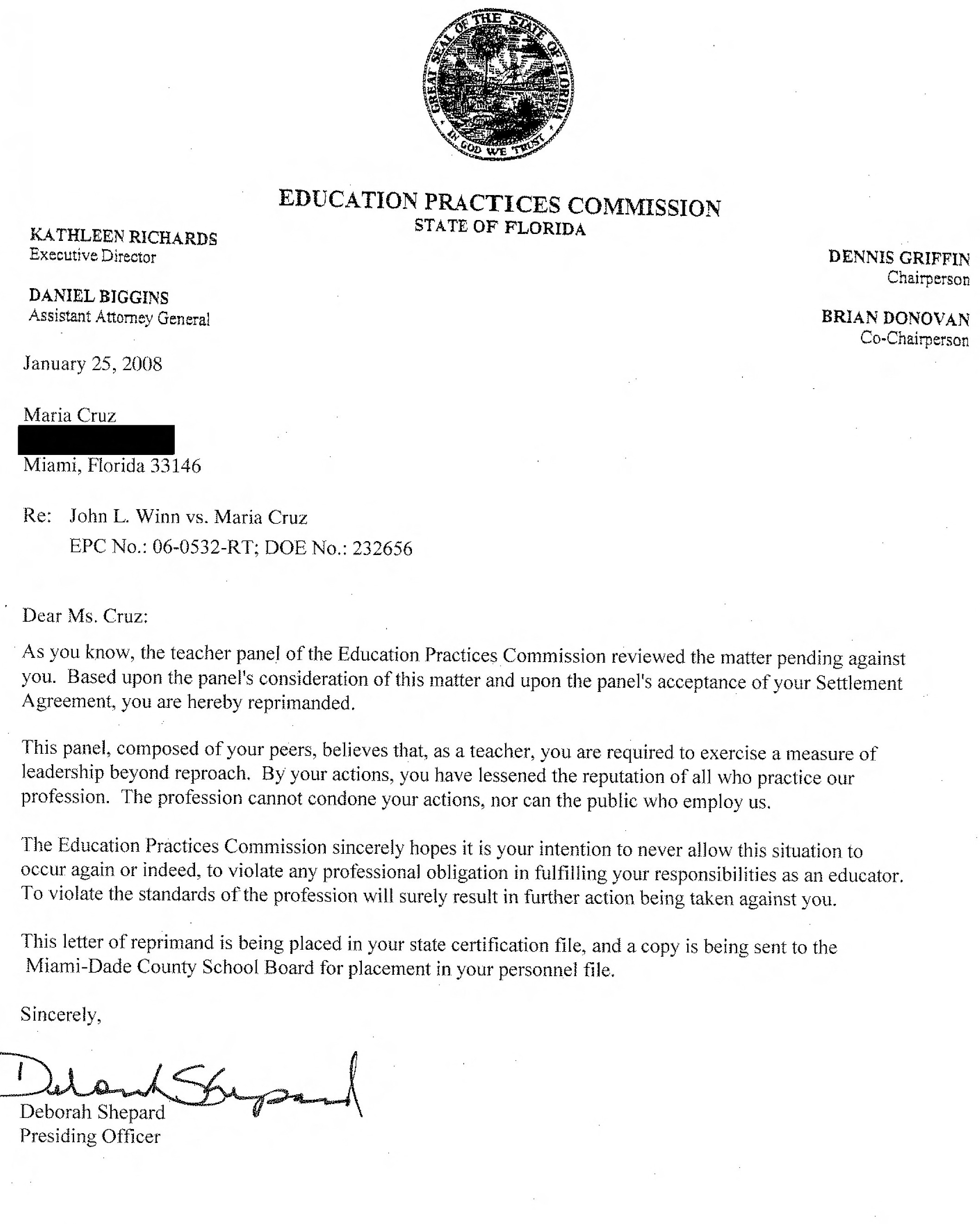
In the final analysis, Mrs. Cruzchev is free to live out whatever fever dream she’s constructed for herself, sincere or otherwise. I’m just not willing to fund it.
Wow — thanks for shining a floodlight on the kind of municipal nonsense that would make even a DMV clerk blush. Nothing says “City Beautiful” like burning through 140 hours of police time so one resident can run her own private security fantasy camp on the taxpayer dime. And the article nails it: if we’re now handing out watch orders based on “I have issues with the mayor” and “he’s a little crazy,” then congratulations, Coral Gables — you’ve essentially created the first publicly funded concierge paranoia service.
What’s wild is that other cities have figured out how to handle these requests like adults. San Benito, for example, won’t even extend a simple vacation watch beyond seven days without a supervisor signing off. Imagine that: a basic check to make sure the city isn’t being gamed like an elderly relative’s Netflix password. And tons of departments — Butler County, to name one — explicitly state that extra patrols happen only when officers aren’t tied up with real emergencies. They don’t promise full-time emotional comfort patrols.
Many places also report how these directed patrols impact staffing and budgets. Portland publishes entire sections of their annual reports showing how directed patrol missions affect overtime and response times. Transparency — you’ve heard of it, right? It’s that thing Coral Gables keeps in a jar somewhere for special occasions.
And here’s another thought: in other cities, when someone wants persistent, ongoing patrols that start looking more like a private security contract, the city just… charges for it. Radical, I know. Some municipalities literally bill for sustained extra patrols or offer formal contracted overtime coverage. Crazy concept: if you want the cops to babysit your driveway every single day, maybe you — not everyone else — should help foot the bill. You know, like grown-ups do.
But even without going full “please swipe your card for additional delusions,” there’s a mountain of obvious fixes staring us in the face. For starters, every watch order should have a clear justification — not the Coral Gables Special of “someone told me to be careful” — and it should automatically expire unless re-approved with actual, documented information. Most cities treat these things like cartons of milk, not like heirlooms you pass down to the next generation.
And if the city wants to avoid this exact fiasco from happening again, it should do what other departments already do: regularly review these orders, kill the ones that no longer make sense, and keep track of how many officer-hours are being siphoned into them. Put it in a simple annual summary so residents don’t have to wait for a FOIA request or an investigative blog post to find out their money is funding Mrs. Cruzchev’s Cold War fan fiction.
If the commission really wants to drag us into the modern era, they could easily adopt the same practices everyone else uses: short time limits, supervisor review, resource-based prioritization, transparent reporting, and optional cost recovery if someone insists they’re the main character in a political thriller that only exists in their head.
Bottom line: I’m completely behind this article. I’m all for public safety, but I’m not interested in financing one person’s never-ending cosplay of “victim of a shadow mayoral manhunt.” Let’s stop pretending that this is normal, rein in the watch-order circus, and make the police department focus on — you know — actual crime.
Because at the end of the day, she’s free to live in her own reality. I just don’t want my tax dollars paying rent there.
Congratulations for pointing out much truth, no one cares to say. Many are scared of this person.
She has a vicious tongue, no matter whether truth or false.
Thank you ... and God bless you Aesop.